

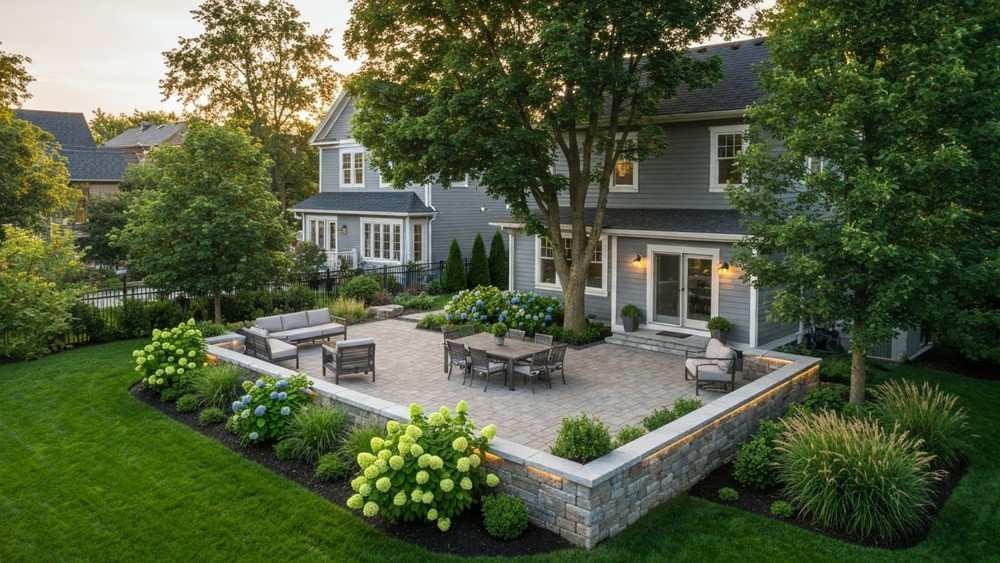
Small yards get a bad reputation. People look at their 20-by-30-foot backyard and immediately start listing what they can’t do. Can’t fit a pool. Can’t have a proper patio and a lawn. Can’t do much of anything, really.
I hear this all the time. And it’s wrong almost every time.
The truth is that small properties force better design decisions. When you have unlimited space, it’s easy to scatter features around without much thought. When every square foot matters, you actually have to plan. And planned spaces almost always feel better than sprawling ones.
Stop Thinking in Single Zones
The biggest mistake with small yards is trying to turn the entire space into one thing. People pave the whole area for a patio, or they lay sod wall-to-wall for a tiny lawn. Either way, it ends up feeling monotonous.
Even in a compact yard, you can create two or three distinct zones. A dining area near the house. A small lounging spot farther back. A strip of planting along the fence. The zones don’t need to be large. What matters is that they feel different from each other, so moving through the space has some sense of progression.
Level changes are your best friend here. Even raising one section by six inches on a small timber-framed platform creates the illusion of a separate room. Your brain registers the change in elevation as a boundary, even without a wall or hedge.
Vertical Space Is Free Real Estate
When you can’t expand outward, go up. This isn’t just about hanging planters, though those work fine. It’s about rethinking how you use vertical surfaces.
A fence doesn’t have to be just a boundary. Attach narrow cedar shelves and you’ve got herb garden storage. Install a trellis panel with climbing jasmine or clematis and you’ve added a living wall that smells incredible in summer. Mount a fold-down table to the fence for a prep surface that disappears when you don’t need it.
Pergolas work differently in small spaces too. In a big yard, a pergola defines one area. In a small yard, a pergola over the entire patio creates a ceiling that makes the outdoor space feel like a room. Train vines across the top and you get dappled shade without giving up any floor area.
Pick Furniture That Earns Its Space
Standard patio furniture is designed for standard patios. If your yard is compact, you need pieces that do double duty or fold away.
Built-in seating along a fence or retaining wall is one of the best moves for a small property. You get seating for six or eight people without any movable chairs eating up floor space. Build storage underneath and the bench becomes even more valuable.
For tables, look at wall-mounted drop-leaf designs or narrow bistro tables rather than full dining sets. You can seat four at a 28-inch round table, and when you fold it up, that floor space is open for kids to play or for you to do yoga or whatever else you actually use your yard for.
Smart Planting Makes Small Yards Feel Larger
Plant selection in a small yard needs discipline. It’s tempting to buy one of everything at the garden center, but a dozen different species in a tiny bed looks chaotic, not lush.
Pick three or four plant varieties and repeat them. Repetition creates rhythm, and rhythm makes a space feel organized and larger than it is. Use tall, narrow plants like columnar cedars or Karl Foerster grasses along boundaries. They give you height and screening without the three-foot spread of a regular shrub.
Color matters too. Cool colors (blues, purples, silvers) recede visually and make boundaries feel farther away. Warm colors (reds, oranges, yellows) jump forward. So put your warm-toned plants near the house where you sit, and your cool-toned plants at the back fence. The yard will feel deeper.
Lighting Creates a Whole Second Yard
A small yard that’s well-lit at night effectively doubles your enjoyment of the space. String lights overhead create ambiance fast. But if you want it to really feel designed, add two or three ground-level fixtures.
An uplight at the base of a small tree throws interesting shadows on the fence and ceiling. A recessed light in a step or bench riser adds safety and drama. Path lighting along a short walkway (https://www.montrealpaysagementpro.com/) sounds unnecessary in a small space, but it draws your eye through the yard and creates a sense of journey that counteracts the compact dimensions.
Warm-toned bulbs (2700K) make outdoor spaces feel cozy. Daylight-toned bulbs (5000K+) make them feel like a parking lot. Don’t mix them up.
Don’t Forget the Ground Plane
The surface you walk on does a lot of heavy lifting in a small yard. A single material floor-to-fence makes the space feel flat and boring. Mixing two materials (pavers and pea gravel, or wood decking and stone) adds texture and helps define those zones I mentioned earlier.
A diagonal paver pattern makes a narrow yard feel wider. Running long boards lengthwise on a deck makes a short space feel deeper. These are old tricks, but they keep working because human perception hasn’t changed.
Leave some gaps in your hardscaping for ground cover plants like creeping thyme or Irish moss. They soften the look, smell good when stepped on, and don’t need mowing.
The Bottom Line
Small properties aren’t a compromise. They’re a design constraint, and constraints breed creativity. The most enjoyable outdoor spaces I’ve seen aren’t the biggest ones. They’re the ones where someone thought carefully about every element and made each piece serve a purpose.
If your yard is small, stop wishing it was bigger. Start designing it like every square foot has a job to do. You’ll be surprised how much living you can fit into a space you thought was too small to bother with.
Author Bio: Denis, founder of Montreal Paysagement Pro, a residential landscaping company serving Greater Montreal, Laval, and the South Shore.